
O Master, from your compassion bless me.
Bless me that I may cut the illusory visions of the bardo.
Bless me that I may reconnect the mother voidness and the son awareness.
Excerpt from the Bardo Prayer by Tenzin Wangyal Rinpoche
Embarking on the Next Journey: What Happens When We Die?
In the Tibetan spiritual traditions, death is not an end but a passage—an unfolding journey through subtle stages of dissolution and transition. As the body releases its final breath, consciousness begins a sacred movement through the bardo, the intermediate state between death and rebirth. In this space, the clear light of awareness may be recognized, and visionary experiences arise—sometimes peaceful, sometimes intense—reflecting the patterns of one’s own mind.
With preparation, this journey can unfold with greater clarity and openness. This is why taking time during our lives to reflect on the end of life is so important—not only for ourselves, but also for those who may accompany and support us in our passing. Simple practices offered at the time of death, such as prayers or mantra, the offering of light, the lighting of 108 candles, or the recitation of the Precious Garland, help create a field of blessing, comfort, and compassion, gently supporting the one who has passed through this sacred transition.
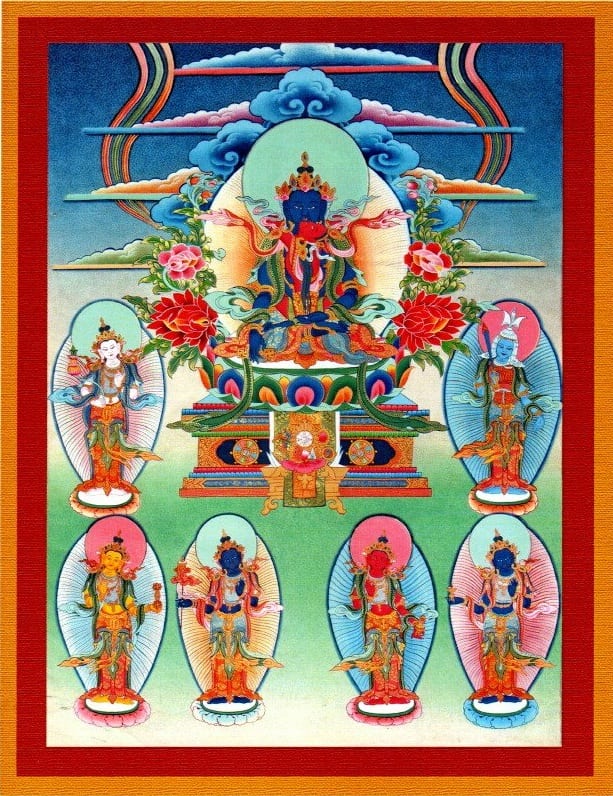
Shenlha Okar, Sherap Chamma and the Buddhas of the Six Realms (Lokas)
Supporting Your Loved One’s Journey Through the Bardo with Love and Practice
In the Tibetan spiritual traditions, the 49 days after death are regarded as a sacred passage, a time when the consciousness of the departed moves through the bardo—the transition between death and rebirth. During this time, various subtle emotions or inner experiences may arise, much like the dreams or reflections we encounter in life. Just as in life, these too, can be embraced with loving-kindness, generosity, openness, peace, and compassion.
As family, friends, or members of the sangha, we can offer steady support through our prayers, presence, and heartfelt intention. Recitation of prayers, the MA TRI mantra, and the dedication of merit become offerings of love—helping to guide and comfort the one who has passed as they continue their journey.

Lighting Candles
Lighting 108 butterlamps, or tea lights, and having them burn continuously for the 3 days and nights is traditionally done to honor those who have passed away. If this is not possible, light as many tea lights as possible during this time period.

Precious Garland, Bardo Prayers & Recitation of the Ma Tri Mantra
Traditionally, after one has passed, for those who live near a monastery, the Precious Garland prayer would be recited by monks continuously for 3 days and nights. We can continue this tradition by reciting this prayer as many times as possible. The MA TRI mantra, one of the three Bön Heart mantras, can be recited by friends and loved ones as a support for the journeyer.
Welcoming the Support of the Lineage and the Ligmincha Community

Requesting Prayers & Rituals from Ligmincha lamas
The prayers and rituals offered by our lamas carry deep blessings and spiritual support. These sacred offerings help to guide the consciousness, ease suffering, and honor the sacredness of the journey.

Requesting Support from the Sangha
We offer several ways for you to both receive and extend support—whether for your family, a loved one, or members of our sangha community. In the strength of collective practice, prayer, and compassion are shared offerings.
Reciting Prayers & Mantras
Precious Garland Prayer
[add link to audio recording]
[add link to pdf]
Bardo Prayer by Tenzin Wangyal Rinpoche
[add link to audio recording]
[add link to pdf]
MA TRI Mantra
[add link to audio recording]
[add link to pdf]
How to Request Prayers & Rituals
For information on how to request prayers or rituals from Geshe Denma Gyaltsen
Resident Lama of Ligmincha Texas
Click Here
For information on how to request prayers or rituals from Geshe Yungdrung Gyatso
Resident Lama of Ligmincha Poland
Click Here
For information on how to request prayers or rituals from Lama Kalsang Nyima
Resident Lama of Ligmincha Mexico
Click Here
For information on how to request prayers or rituals from Lama Yungdrung Lodoe
Resident Lama of Ligmincha Mexico
Click Here
For information on how to request prayers or rituals from Menri Monastery, India
Click Here
For information on how to request prayers or rituals from Triten Norbutse Monastery, Nepal
Click Here
Honoring with the Heart: Creating Merit Through Charity
Making a donation in the name of someone who has passed is a meaningful way to create merit for them—sonam in Tibetan. In the Tibetan tradition, this act of generosity is known as gewa, a practice that generates merit not only for the deceased, but also for the one who offers it.
You may choose to support a cause that was meaningful to them, or make an offering to a monastery or spiritual community with which they felt a connection. Such acts of generosity can be dedicated as merit for their benefit. Even simple offerings, when made with sincere intention, are said to become a powerful expression of care—supporting their passage through the bardo—the intermediate state between death and rebirth—while deepening our own sense of love and connection.
TITLE
Lorem ipsum dolor sit amet, consectetur adipiscing elit, sed do eiusmod tempor incididunt ut labore et dolore magna aliqua. Ut enim ad minim veniam, quis nostrud exercitation ullamco laboris nisi ut aliquip ex ea commodo consequat.
Honoring the Anniversary Through Acts of Virtue
In the Bön tradition, the one-year anniversary of a loved one’s passing—and each year that follows—is a meaningful time to engage in virtuous actions on their behalf. This may include reciting prayers, lighting butter lamps, hanging prayer flags, making charitable offerings, or liberating the lives of animals.
You may also choose to request prayers from a monastery. These acts of devotion continue the bond of love beyond this life.

Chi Go Prayer Flags, Dolanji
Special prayer flags raised on the one-year anniversary of the deceased
HANGING PRAYER FLAGS
Lorem ipsum dolor sit amet, consectetur adipiscing elit, sed do eiusmod tempor incididunt ut labore et dolore magna aliqua. Ut enim ad minim veniam, quis nostrud exercitation ullamco laboris nisi ut aliquip ex ea commodo consequat.